10,000+ English teachers have been reading this newsletter for 6 years: penned by teacher trainer, researcher and mediocre knitter Chiara Bruzzano, the Sunday newsletter brings you tips for teaching languages and learning English, insights into the quirkiness of British life and support for the Italian concorsi docenti. Every Sunday (ish...) straight to your inbox. Join us, it's free ✨
Leaves are falling, temperatures are dropping, and that pesky evening darkness arrives earlier and earlier with each passing day: it's safe to say, Autumn is upon us 🍂
I live in a place where the sun will soon go down at 3.30PM (yeah, you read that right), which tends to fill me with a sense of gloom that only hot chocolate seems to soothe.
In anticipation of this, however, towards the end of October I always go to a really cool arts and lights festival called Light Night¹. And I didn't miss it this year either: a little bit of spectacular light-based art installations scattered around town can fill the heart of a gloomy girl.
Just to share a little glimpse of what the Anglo-Saxons can do with lights, here's one of the main installations about the history of the suffragettes 👇
But there's also interesting stuff for the more sport-minded:
Another very clear sign of the arrival of autumn is the proliferation of pumpkins, cobwebs, spiders, more or less scary ghosts: in short, your typical, and inevitable, Halloween paraphernalia.
I bet you'll be covering Halloween in your lessons one way or another, and I'm always here to make suggestions that support you with these topics. However, you may remember that this month, I've written to you about the theme of "new perspectives on things you (kind of) already knew", so in today's newsletter, you will get:
5 more traditional Halloween classroom activities
5 alternative ways of covering Halloween in class this year (plus a bonus one)
Have you got your spooky costume on? Good, neither do I, so: let's get cracking 👻
5 more traditional Halloween lesson activities
If you want to go down a slightly better-travelled route, here are 5 resources you might like to consider:
1. Halloween lesson plan
In this British Council lesson plan for A1/A2 level learners, students practise Halloween vocabulary, sing a song and/or watch a story. Depending on the stages chosen, they then invent an animal skeleton, write a spooky story, imagine some animals in a haunted house and/or invent a magic potion. Finally, they make a paper skeleton, then write and talk about it.
2. Crosswords
Fancy a little challenge? Choose one of the crosswords from Lanternfish ESL to find out all about Halloween and do a bit of vocab work.
3. Word games
Practise Halloween vocabulary with these two interactive word matching games (one and two) from British Council Learn English Kids.
4. Handouts, reading texts and flashcards
All of the above, graded for different levels from A1 to C2, available thanks to the folks at World of Better Learning.
5. Listening + focus on adjectives
You might not expect it, but there is actually a whole website devoted to turning football into lesson materials for English learners. For some reason, this very website also created a lesson plan (aimed at, conservatively, A2, but more likely B1), complete with a listening activity and follow-up exercises focusing on the language to talk about fear, including gradable and ungradable adjectives and -ed/-ing endings.
This is the approximate level of spookiness my faint heart can tolerate
5 alternative ways to do Halloween this year
Now, maybe you've done Halloween in class a hundred times and are looking for something a bit new/more flashy; maybe you're not a mega fan of all things spooky², so you could really use a different angle on this holiday. Whatever the case, here are 5 ideas for a slightly alternative twist on Halloween.
1. Things I hate/dislike/don't understand about Halloween
Who says everyone has to be a Halloween fan? If you're doing Halloween, a very common activity is to brainstorm traditions and their related vocabulary. A twist on this brainstorm is for students to share things they hate, dislike or don't understand about Halloween. That will likely a) get you the brainstorm you were aiming for; b) allow you to fill the gaps in the learners' knowledge about the things they don't understand - a bit of Test-Teach-Test - and c) allow your learners to express a personal opinion. This personalises learning and gives them an authentic purpose for sharing: if you think about it, in a real life conversation, is it more realistic to share everything you can think of about X topic, or to share what you dislike/hate/don't understand about X topic? Plus, everybody likes a bit of venting, if I do say so myself...
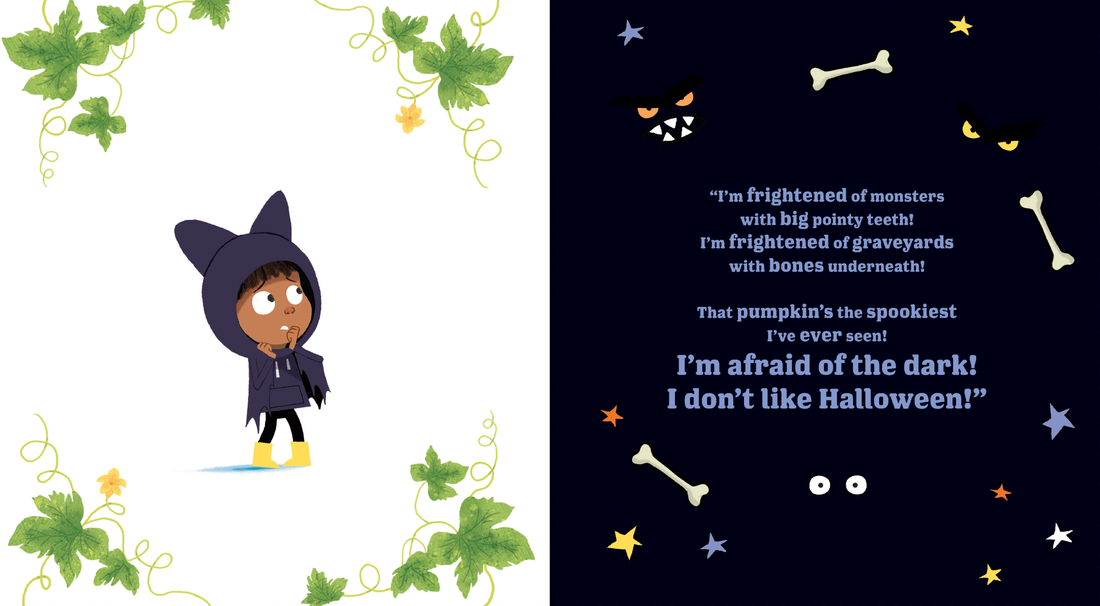
From "The pumpkin who was afraid of the dark"
2. The origin of things
After you do a brainstorming activity, you will likely have a list of common Halloween symbols and traditions. These might include things like jack-o-lanterns (you might need to feed the name), scary costumes, trick or treating, and so on. These are now staples of Halloween, so your students may have never thought about why they exist. Why do we go trick or treating? Why are the costumes scary? Have your learners come up with hypotheses (the crazier, the better!) and then either confirm them or let them find the answers. This article on the origins of Halloween traditions could be a good starting point.
3. Is it American, though?
By the anno domini 2025, we are somewhat accustomed to thinking of Halloween as a very American holiday. It's true that the US is probably the country where the biggest celebrations take place; however, where do the various traditions associated with Halloween actually come from? Even simply perusing the Wikipedia page for Halloween will help your learners identify all the things that are actually totally unrelated to the US.
4. History and Halloween
When did Halloween originate? How was it integrated into Christianity? And how did it co-exist with Guy Fawkes' Night, which is only a few days after? Take the opportunity to review a bit of history, and perhaps a bit of literature, through the history of Halloween. Ask your learners to go through the Wikipedia page for Halloween and identify all of the historical facts they can find that they have studied and put them on a timeline.
5. Do you believe in superstitions?
Ghosts, spirits, the afterlife: Halloween is connected to so many superstitions. Have your learners make a list of them and then expand the list with other superstitions, maybe those that are popular in their home countries. Where do they come from? Why do people believe them? Do your students believe in any of them? Open up the floor for (moderated) discussion.
Bonus activity: Halloween (and Halloween-adjacent) traditions from around the world
El dia de los muertos, Ognissanti, Samhain: there is no shortage of traditions from various countries. Use this article (or simplify it depending on your students' level) as a reading activity and let your students choose their favourite alternative tradition. And if you'd like a focus on the Gaelic roots of Halloween, here's a little article on Sahmain: 6 ways to celebrate Halloween like a pagan.
That's it for today's spookiness! I hope these activities are useful next week and if you use any of them, let me know how they go.
I wish you strength on this Sunday when the clocks have gone back.
Take care, dear teacher ✨
¹ I'm happy to give credit to whoever named the festival for a good, effective name; however, dear reader, the times I have been able to say this name correctly on the first try are exactly 0. I always go with "night light" (i.e. that little light you have on at night for children), not light night, which reveals again the power of lexical chunks - once one is safely stored in your mind, it's hard to disrupt the status quo!
² I'm right there with you. The list of things my faint little heart can't take includes, but is not limited too, horror movies, horror-adjecent movies, haunted houses, sudden screams, cobwebs, scary costumes, elaborate wound make-up and people walking down a dark corridor who think "let's split up" is a good idea. This is roughly the level of Halloween I'm comfortable with.
P.S.: My weekly suggestion for things to listen to/watch/read to improve your English while relaxing: To conclude the Halloween theme, here is an accurate (and funny) rendition of what most horror movies look like to me.
✨Cool things I heard this week
Thanks for the updates in the course for the concorso. I'm so glad I don't have to buy a new one and they're all included!
What did you think of today's newsletter?
❤️ I loved it: well, thank you so much! Hit "reply" to let me know (it makes my day) or hit "forward" and send it to a friend
👉 I'm new, a friend sent me this: great to have you here! To receive this newsletter every Sunday (ish), for free, subscribe here
🚀 I want more: no problem - check out all my previous newsletters with tips, lesson plans and ramblings here or join our YouTube channel
👎🏻 Meh, I'm not sure: that's absolutely fine: you can Unsubscribe from the Sunday newsletter.
10,000+ English teachers have been reading this newsletter for 6 years: penned by teacher trainer, researcher and mediocre knitter Chiara Bruzzano, the Sunday newsletter brings you tips for teaching languages and learning English, insights into the quirkiness of British life and support for the Italian concorsi docenti. Every Sunday (ish...) straight to your inbox. Join us, it's free ✨
Read more from The Sunday(ish) newsletter - LanguagEd
Join 10,450 readers Add your words to our community Padlet Dear Reader, Raise your hand if you're also currently scrambling for Halloween activities that are: ✔️ a little fun, because those kids are starting to feel *tired* ✔️ ready-made, because AI is okay and all, but who has the time to reinvent the wheel? ✔️ suitable for your students' levels, because pre-teaching 37 words to watch a 2-minute video just sounds like bad economics ✔️ new, because you've done the same thing over and over...
Join 10,450 readers Add your words to our community Padlet Dear Reader, Can I just say: rejoice, it's the weekend! The leaves are leaving (the trees), the pumpkin spice is non-negotiably coming and we have all survived over a month of the school year. Let's take a moment to pat ourselves on the back.¹ The leaves are definitely starting to leave on my commute As for me? I'm trying to take in the last few rays of sunshine while trying not to dispair that I've had the heating on for a month...
Join 10,450 readers Add your words to our community Padlet Dear Reader, While I missed you a lot last Sunday, there is one thing I missed even more: the ability to breathe unimpeded. I had one of the most horrendous flu bugs I've ever had, and it was only late September. One would hope the inevitable endless succession of bug after bug would start a little later in the year, but alas. I could describe my state by saying that this bug floored me, or that it hit me like a ton of bricks, but...